content type paperpublished March 2026
GenCtrl — A Formal Controllability Toolkit for Generative Models
AuthorsEmily Cheng†, Carmen Amo Alonso‡, Federico Danieli, Arno Blaas, Luca Zappella, Pau Rodríguez, Xavier Suau
GenCtrl — A Formal Controllability Toolkit for Generative Models
AuthorsEmily Cheng†, Carmen Amo Alonso‡, Federico Danieli, Arno Blaas, Luca Zappella, Pau Rodríguez, Xavier Suau
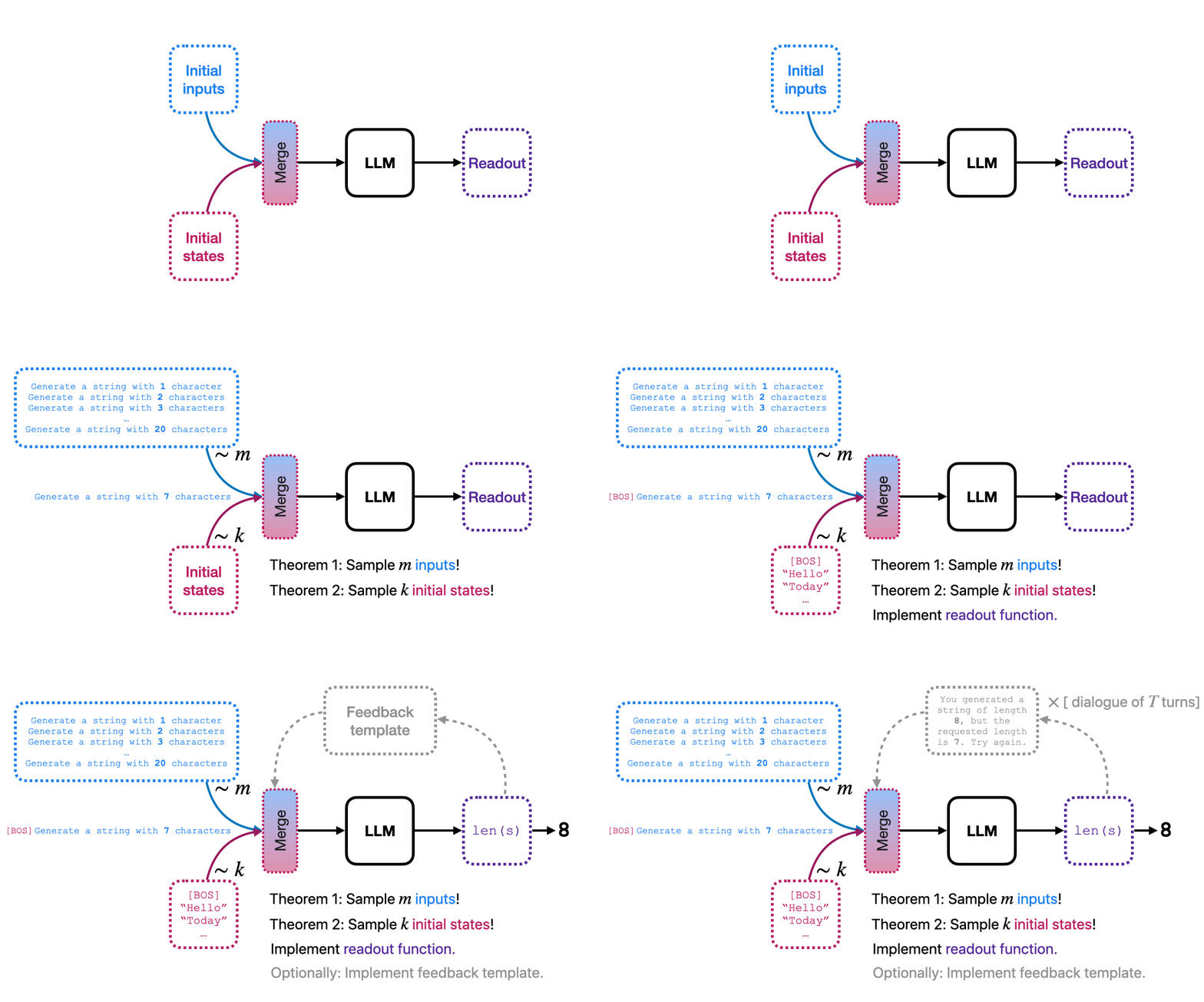
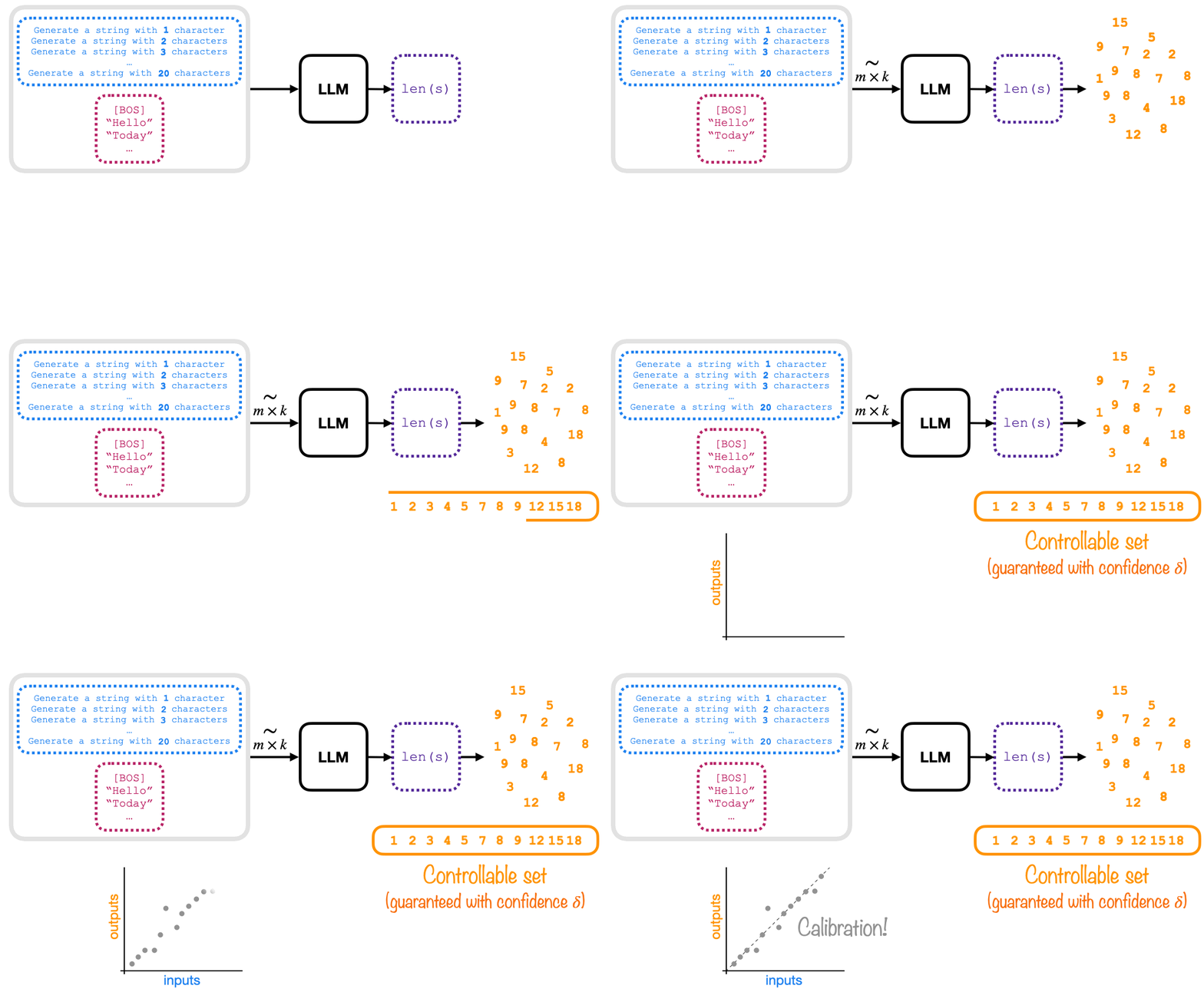
As generative models become ubiquitous, there is a critical need for fine-grained control over the generation process. Yet, while controlled generation methods from prompting to fine-tuning proliferate, a fundamental question remains unanswered: are these models truly controllable in the first place? In this work, we provide a theoretical framework to formally answer this question. Framing human-model interaction as a control process, we propose a novel algorithm to estimate the controllable sets of models in a dialogue setting. Notably, we provide formal guarantees on the estimation error as a function of sample complexity: we derive probably-approximately correct bounds for controllable set estimates that are distribution-free, employ no assumptions except for output boundedness, and work for any black-box nonlinear control system (i.e., any generative model). We empirically demonstrate the theoretical framework on different tasks in controlling dialogue processes, for both language models and text-to-image generation. Our results show that model controllability is surprisingly fragile and highly dependent on the experimental setting. This highlights the need for rigorous controllability analysis, shifting the focus from simply attempting control to first understanding its fundamental limits.
Plan-then-Generate: Controlled Data-to-Text
October 25, 2021research area Speech and Natural Language Processingconference EMNLP
Recent developments in neural networks have led to the advance in data-to-text generation. However, the lack of ability of neural models to control the structure of generated output can be limiting in certain real-world applications. In this study, we propose a novel Plan-then-Generate (PlanGen) framework to improve the controllability of neural data-to-text models. Extensive experiments and analyses are conducted on two benchmark datasets, ToTTo…
Structured Control Nets for Deep Reinforcement Learning
February 22, 2018research area Computer Visionconference ICML
In recent years, Deep Reinforcement Learning has made impressive advances in solving several important benchmark problems for sequential decision making. Many control applications use a generic multilayer perceptron (MLP) for non-vision parts of the policy network. In this work, we propose a new neural network architecture for the policy network representation that is simple yet effective. The proposed Structured Control Net (SCN) splits the…

Our research in machine learning breaks new ground every day.