content type paperpublished May 2025
SPD: Sync-Point Drop for Efficient Tensor Parallelism of Large Language Models
AuthorsHan-Byul Kim, Duc Hoang, Arnav Kundu, Mohammad Samragh, Minsik Cho
SPD: Sync-Point Drop for Efficient Tensor Parallelism of Large Language Models
AuthorsHan-Byul Kim, Duc Hoang, Arnav Kundu, Mohammad Samragh, Minsik Cho
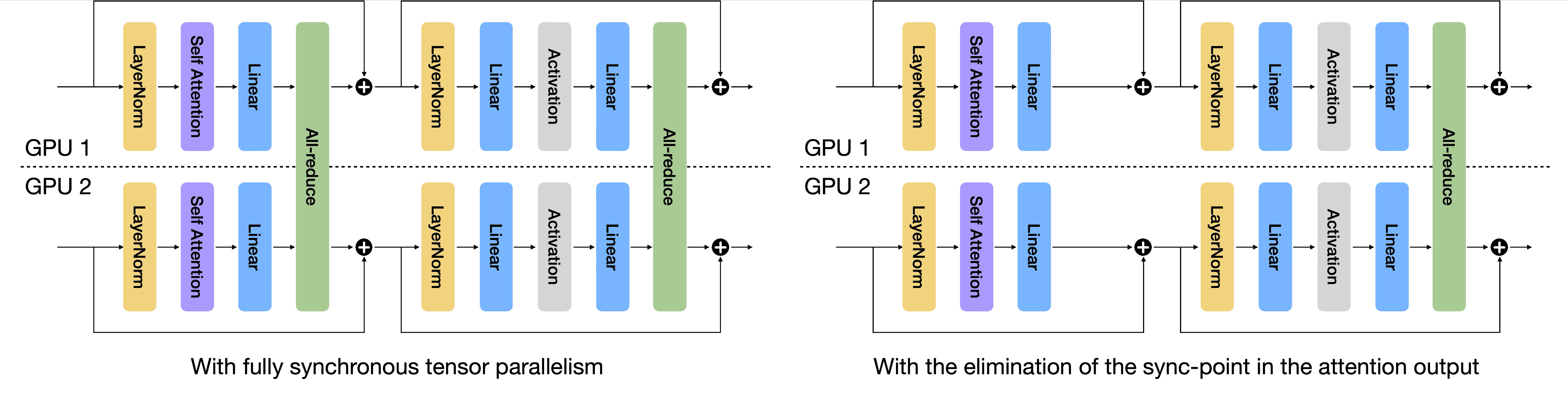
With the rapid expansion in the scale of large language models (LLMs), enabling efficient distributed inference across multiple computing units has become increasingly critical. However, communication overheads from popular distributed inference techniques such as Tensor Parallelism pose a significant challenge to achieve scalability and low latency. Therefore, we introduce a novel optimization technique, Sync-Point Drop (SPD), to reduce communication overheads in tensor parallelism by selectively dropping synchronization on attention outputs. In detail, we first propose a block design that allows execution to proceed without communication through SPD. Second, we apply different SPD strategies to attention blocks based on their sensitivity to the model accuracy. The proposed methods effectively alleviate communication bottlenecks while minimizing accuracy degradation during LLM inference, offering a scalable solution for diverse distributed environments: SPD offered about 20% overall inference latency reduction with <1% accuracy regression for LLaMA2-70B inference over 8 GPUs.
Parallel Track Transformers: Enabling Fast GPU Inference with Reduced Synchronization
February 10, 2026research area Methods and Algorithms
Efficient large-scale inference of transformer-based large language models (LLMs) remains a fundamental systems challenge, frequently requiring multi-GPU parallelism to meet stringent latency and throughput targets. Conventional tensor parallelism decomposes matrix operations across devices but introduces substantial inter-GPU synchronization, leading to communication bottlenecks and degraded scalability. We propose the Parallel Track (PT)…
Towards Low-Bit Communication for Tensor Parallel LLM Inference
November 19, 2024research area Methods and Algorithms, research area Speech and Natural Language ProcessingWorkshop at NeurIPS
This paper was accepted at the Efficient Natural Language and Speech Processing (ENLSP) Workshop at NeurIPS 2024.
Tensor parallelism provides an effective way to increase server large language model (LLM) inference efficiency despite adding an additional communication cost. However, as server LLMs continue to scale in size, they will need to be distributed across more devices, magnifying the communication cost. One way to approach this problem…

Our research in machine learning breaks new ground every day.