We present SHARP, an approach to photorealistic view synthesis from a single image. Given a single photograph, SHARP regresses the parameters of a 3D Gaussian representation of the depicted scene. This is done in less than a second on a standard GPU via a single feedforward pass through a neural network. The 3D Gaussian representation produced by SHARP can then be rendered in real time, yielding high-resolution photorealistic images for nearby views. The representation is metric, with absolute scale, supporting metric camera movements. Experimental results demonstrate that SHARP delivers robust zero-shot generalization across datasets. It sets a new state of the art on multiple datasets, reducing LPIPS by 25-34% and DISTS by 21-43% versus the best prior model, while lowering the synthesis time by three orders of magnitude.
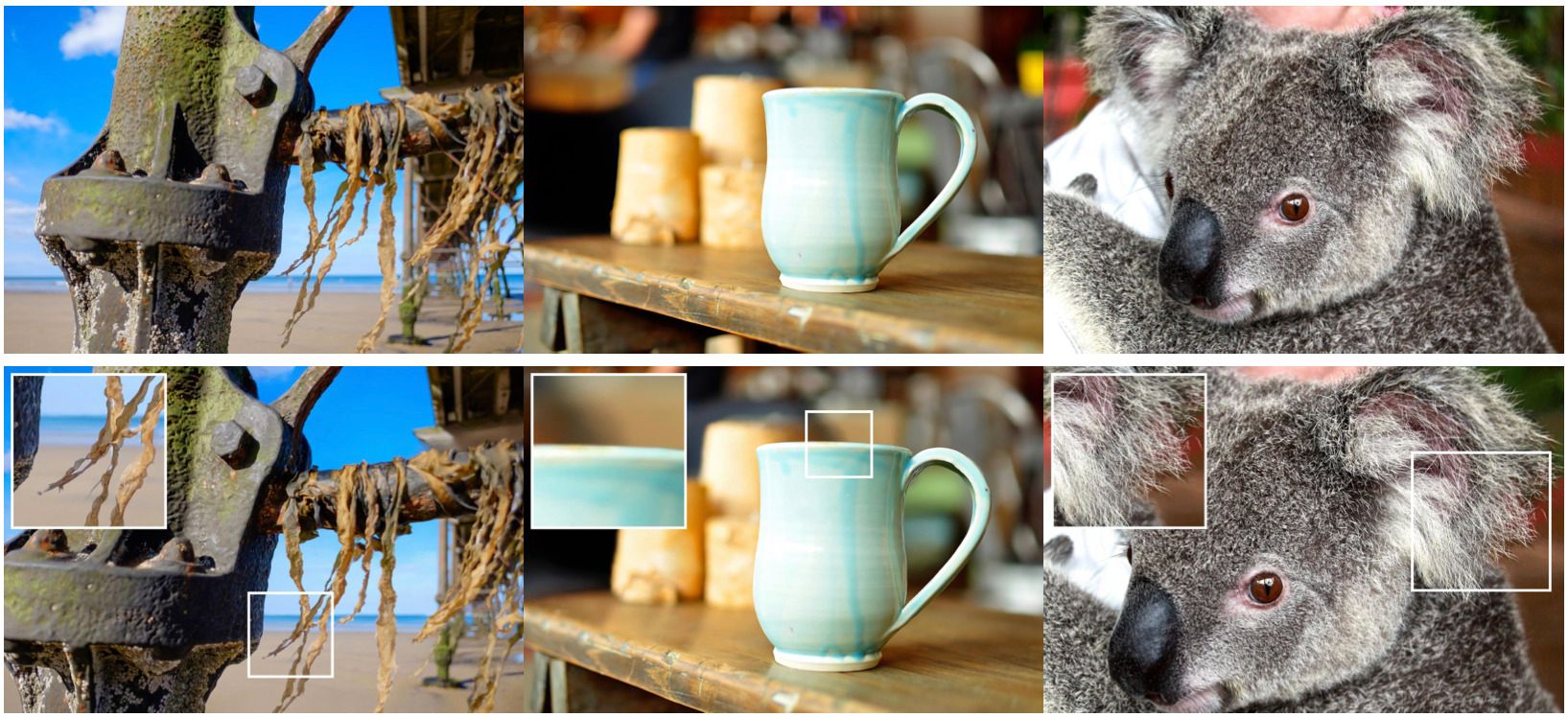
Figure 1: SHARP synthesizes a photorealistic 3D representation from a single photograph in less than a second. Top: Input image; Bottom: Novel view synthesized by SHARP. The synthesized representation supports high-resolution rendering of nearby views, with sharp details and fine structures, at more than 100 frames per second on a standard GPU.
We propose HeadsUp, a scalable feed-forward method for reconstructing high-quality 3D Gaussian heads from large-scale multi-camera setups. Our method employs an efficient encoder-decoder architecture that compresses input views into a compact latent representation. This latent representation is then decoded into a set of UV-parameterized 3D Gaussians anchored to a neutral head template. This UV representation decouples the number of 3D Gaussians…
We study the problem of novel view synthesis from sparse source observations of a scene comprised of 3D objects. We propose a simple yet effective approach that is neither continuous nor implicit, challenging recent trends on view synthesis. Our approach explicitly encodes observations into a volumetric representation that enables amortized rendering. We demonstrate that although continuous radiance field representations have gained a lot of…